Muslim Parents are facing a lot of difficulties in raising their kids these days.

May 05, 2026

Muslim Parents are facing a lot of difficulties in raising their kids these days.

Many parents come to me and complain that their kids have anger issues, anxiety issues, and they react faster and more aggressively; they struggle to stay calm, and now they don't know how to deal with it.

And it’s not just the parents that are noticing this change, being a Quran and seerah teacher i have been helping children and their parents with Deen, life skills and character development for over 30 years.

Over time i am too observing major changes in children’s behaviour and emotions.

In the past, children were naturally more focused, more obedient, and less exposed to outside influence.

I used to teach five-hour classes with just short breaks, and they loved it. They still remember those classes with pride and joy. Learning Deen made sense to them, they took satisfaction in it, and they were present.

Today, children struggle to stay focused. Their attention spans are shorter, and their minds are constantly pulled by stimulation.

There is also a major shift in behaviour. Children are more influenced by social media than by parents or teachers. What used to be peer pressure is now constant social media pressure.

This shows up as stubbornness, confusion, and laziness, with no interest in learning new things and questioning everything without grounding.

Mothers come with real concerns. They are struggling with behaviour at home. They are confused about modesty, especially for their daughters. Their kids are emotionally weak and vulnerable, getting bullied at school, acting too smart while having no clue about the realities of life. Having too much information and no knowledge, becoming arrogant due to the information they have on any topic, but not using that information for anything great.

And on top of that, parents are worried because their children are learning what is right and wrong from social media instead of the Deen. Social media pressure is real and sometimes is beyond parents' understanding. More and more kids are feeling anxious and going into depression due to the use of screens without need.

I once asked an eight year old student what she was struggling with, and she said, “I am trying to stay focused, I even open my eyes wide, but my brain doesn’t get it.”

I thought about it for days and then I realized that the problem is not a lack of willingness; poor kids are overloaded and tired. They doomscroll all day and loose focus when trying to do something productive.

I have been working on this problem for some time and now I am trying to build systems just to help them stay present.
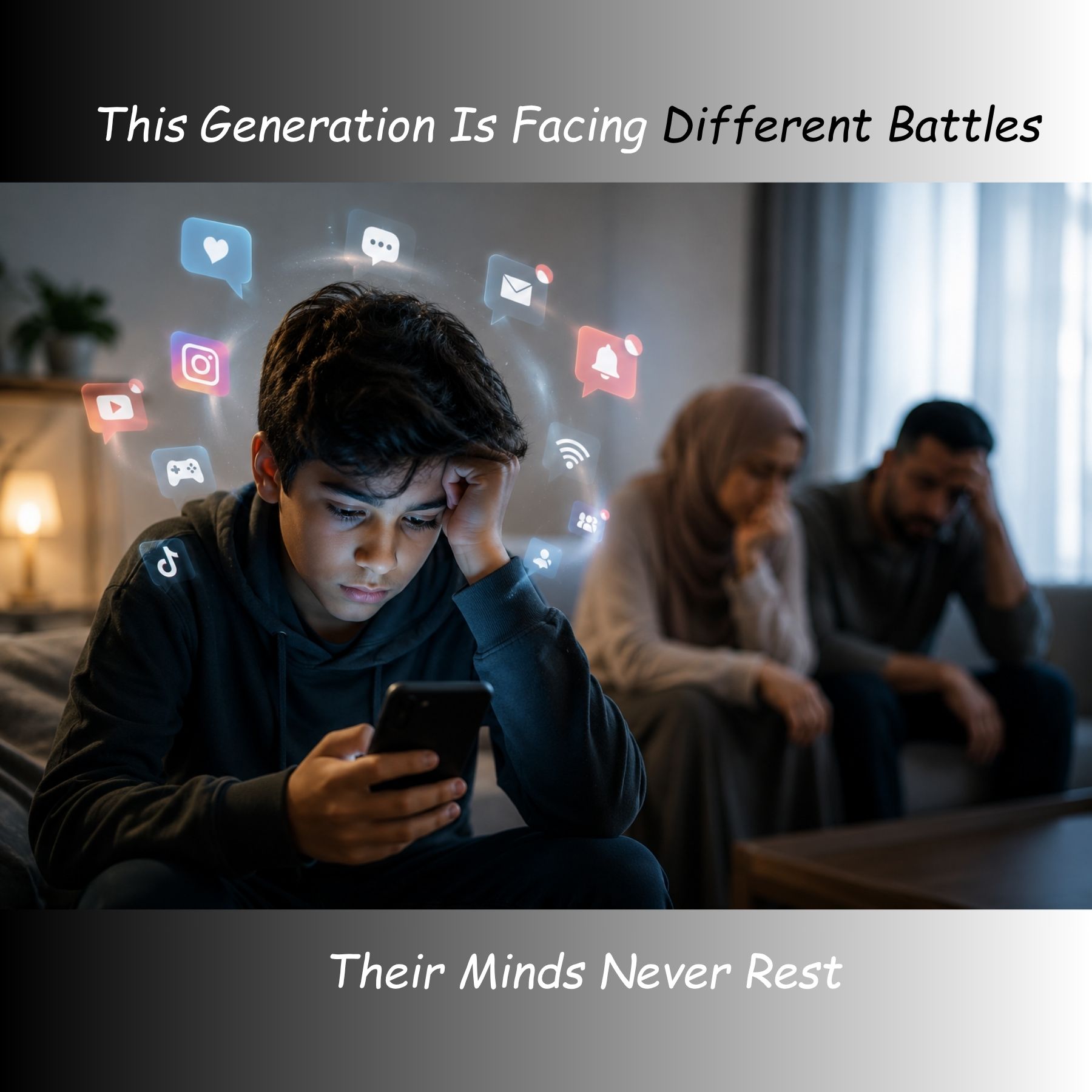
Today’s problems are not small, and they came to us as surprises; we were not ready for them. We thought the hikma and knowledge that our parents used on us would work on our children, too, but here we are facing a completely new kind of forces to fight with to save our children from modern-day fitnaas. We had to move to defensive positions from the offence. Instead of building leaders, parents have been pushed to protect.

Children are growing up in social media noise. They are receiving content, information, opinions, and lifestyles that they are not ready to process. What is right and wrong is no longer coming clearly from parents, teachers or Deen; it is coming from trends, influencers, and what gets attention.

This is creating deep identity confusion. A child does not know who they are supposed to be. One voice says one thing, another says something else. Without a strong grounding, they start building themselves based on what they see, not what is true.

Because of this, their connection with Islamic values becomes weak. Deen starts to feel like something that is not part of real life; instead, it feels alien, forced, and not fun at all.

Focus and patience are also breaking. Children struggle to sit, think, reflect, and stay with one idea. Their minds are trained for speed, not depth.

And slowly, distance grows at home.

Parents and children live in the same house, but not in the same world.

Conversations get harder. Understanding gets weaker.

Parents tell me, “It feels like my child is in a glass cube… I can see them, but I cannot reach them.”

It has become easy, and almost normal, for many teens to show disrespect to their parents.

The Prophet ﷺ warned us clearly: “A slave woman will give birth to her master.” (Sahih Muslim)

A time where children act like they have authority over their parents… speaking harshly, making demands, expecting to be served. Instead of honour. Instead of obedience.

He ﷺ also said: “You will surely follow the ways of those before you…” (Sahih al-Bukhari)

Meaning people will copy others blindly, even if it takes them away from truth, exactly what we see today with trends and social media influence.

These are not isolated issues. These are not random problems. These are signs of fitan trials of the end of times that affect how children think, feel, and live.

The Prophet ﷺ warned us about times like this. And in Surah Al-Kahf, Allah shows us exactly how people lose their direction when truth is not held firmly.

If we do not guide our children with clarity… the world will guide them with confusion. And it will not wait.

The right Guidance is still there, but it becomes harder to recognize. You need Baseera to be able to recognize it. Most follow Lahw blindly.

Allah shows us this in Surah Al-Kahf, where even people with knowledge became confused when they did not hold firmly to the truth. And in Surah Maryam, generations came after them who lost their Salah and followed their desires.

The Prophet ﷺ warned us that trials will come one after another.

Unfortunately, we are raising children in times where they are not just growing anymore. They are being tested. Tested in what they see. Tested in what they believe. Tested in who they become.

What we see today is exactly what was warned. Confusion, Too much information and Weak moral clarity.

Allah says: “Say, shall we inform you of the greatest losers in deeds? Those whose effort is lost in worldly life, while they think that they are doing well.”

This is exactly that confusion. Thinking you are right while you are completely off. That is the fitnah we are seeing today.
The Fitnahs of Surah Al-Kahf

Whenever i read surah Al-al Kahf it does not just tell stories. It prepares us for the fitah we are living in today.

The first is the fitnah of Eeman. The group of youth of the cave held onto their eeman when the world around them was against it. Today, children are not losing Eeman because they want to. They are surrounded by confusion, voices, and opinions. There are doubts about everything, everywhere. Holding onto belief today takes courage and strength.

The second is the fitnah of knowledge. The story of Musa and Khidr teaches that not everything is as it seems. Today, children are learning from the internet before they learn from real teachers. They see information, but they do not know what is true. They need humility and need constant, gentle reality checks. They need to gain and trust authentic knowledge, not everything they scroll past.

The third is the fitnah of wealth. The man with the two gardens was tested with what he had. Today, social media is a constant display of wealth, lifestyle, and comparison. Children start to measure their worth by what they see. What they have. What they wear. What others think of them.

The fourth is the fitnah of power. Dhul-Qarnayn had strength and authority, but he used it with justice. Today, people have the same kind of power, but without wisdom and ‘ilm. That is the power of social media. They have millions of followers. Who are their followers? Our children. Our children dream of this kind of following, trend-setting power, and attention. And without guidance, this thirst for power is misused. It becomes about showing off, not responsibility.

We are facing the same titans as mentioned in Surah Al-Khaf. Just in a different form. If we do not connect our children to Surah Al-Kahf, They will face these tests without a map.

The Solution

The solution is not more reminders. It is rebuilding the child from the inside. Teaching the Qur’an so they follow it, not just recite it. Teaching Seerah in a way they feel like they are living in Makkah and Madinah at the time of the Prophet ﷺ. Knowing the companions the way you and I knew our cousins.

This builds a strong, confident Islamic identity. When a child knows who they are… the world cannot easily shake them. But if this is missing… they will still build an identity. Just not from you.

If you want your child to stay close to you, to share their good and bad moments, there are only two paths.

Either you leave them to figure life out alone… in their rooms, on screens, being shaped by what they watch, what they follow, what they repeat… and slowly lose them, even while they are still in your home…

or you build a real relationship. You create safe, healthy communication. You sit with them. You learn with them. You talk about Qur’an, hadith, companions, and even what is happening in the world… not just rules, not just do’s and don’ts. You guide how they think. Because if you don’t… The world will. And the world is not neutral.

This is what real tarbiyah looks like today. We have to protect our children, not just teach them anymore. Protection today does not happen by default. It does not happen just by sending children to classes or giving reminders. Protection today has to be built. With intention.

It will take your time. Not just being around… but being present. It will take your attention. Listening. Asking. Sitting with them. It will take effort. Show up… even if they are distracted. Even when it feels hard. You will have to plan. Not leave their growth to chance. You will have to create systems in your home. Small, consistent routines that shape what they see, what they think, and how they respond. Real conversations. Reflection. Accountability. Helping them connect what they learn… to how they live.

Because children today do not just need information. They need guidance. They need the right company. They need to be around those who are guided so it shows in real life. If you are not shaping your child… something else is.

This is not just theory. This is what children are actually saying. “I rely more on overthinking than Allah.” “I try to control everything.” “I know I should trust Allah… but I don’t.” Some delay Salah. Some get lost in screens. Some want to do better… but feel stuck. They are not refusing. They are struggling.

I do not only teach my students, I also work on how they think and live. In our classes, the Qur’an and Seerah are not stories to finish. They are brought to life. Children start to see themselves in Makkah, in Madinah… they understand what choices looked like, what courage looked like. Our students ask thoughtful questions and we giv eanswers in live space, not textbook answers, It is our core value to answer their actual questions dealing with their confuaions and helping them love and understand who their Raab is and what is their identity and purpose in this life. Our goal is that they understand their role in school, with friends, on screens, in their emotions, and in their decisions. So they take pride in it that Deen is not something separate. It is their lifestyle. It becomes something they use every single day at every step of their life.

With parents, we don’t leave them alone in this. We guide how to communicate, not just what to say, but when to say it and how it lands. We help them understand what their child is actually dealing with today: screens, pressure, confusion, emotions, so they respond with clarity instead of reaction. We stay connected through sessions, messages, and real conversations when things feel stuck. Parents share what is happening at home, and we break it down together. Sometimes it is a small shift in how you speak, sometimes it is setting a boundary, sometimes it is simply understanding your child properly. We focus on balance, between discipline and connection, so the child respects and also trusts. Because parenting today cannot be distant, it has to be guided, supported, and intentional.

We offer ongoing classes for children where they consistently learn, grow, and stay connected to Deen in a way they understand and live. We run character-building programs focused on identity, habits, discipline, and real-life application. This includes building emotional intelligence, understanding their feelings, managing reactions, and learning how to respond with clarity. We guide them in the Qur’an with meaning, tafseer, and Salah, so their connection is real, not surface level. We also introduce them to responsibility and confidence through practical skills, including starting small initiatives and thinking beyond themselves. Alongside this, we hold parent workshops to guide and support parents in navigating today’s challenges with clarity and confidence.

If this spoke to you… start small, but start right. I’ve put together a free parenting guide to help you begin. Inside, you’ll find simple, practical steps you can use right away. A clear understanding of what children today are actually facing. And the Islamic foundation of tarbiyah… what to teach, how to guide, and how to build it at home. This is not a theory. It is what works.

Start here.

For Students:

  • Classes focused on building faith, identity, and character
  • Safe space for questions and learning
  • Surah al-khaf translation tafseer tarbiya
  • Salah
  • Teen CEO
  • Ages 4 to 18

For Parents:

  • Courses on modern Islamic parenting
  • Tools to deal with behavioural and emotional challenges
  • Guidance rooted in Qur’an (especially lessons from Surah Kahf)

For Students

We offer classes for ages 4 to 18, focused on building faith, identity, and character in a way they understand and live. Students learn in a safe space where they can ask real questions, think, and grow without fear. We cover the Qur’an with meaning, including Surah Al-Kahf with translation, tafseer, and tarbiyah, so they understand how it applies to their life today. We build their Salah step by step, helping them connect, not just perform. Alongside this, we work on confidence, responsibility, and leadership through programs like Teen CEO, so they learn how to carry themselves as strong Muslims in the real world.

For Parents

We offer courses focused on modern Islamic parenting, helping you understand what your child is facing today and how to respond with clarity. You will get practical tools to handle behavioural and emotional challenges at home. All guidance is rooted in the Qur’an, especially lessons from Surah Al-Kahf, so you are not guessing what to do; you are guided.

If this made you think differently about your child… start here. I’ve put together a free parenting guide to help you begin. Inside, you’ll find simple, practical steps you can use right away. A clear understanding of what children today are actually facing. And the Islamic foundation of tarbiyah… what to teach, how to guide, and how to build it at home. This is not a theory. It is what works.

Start here!